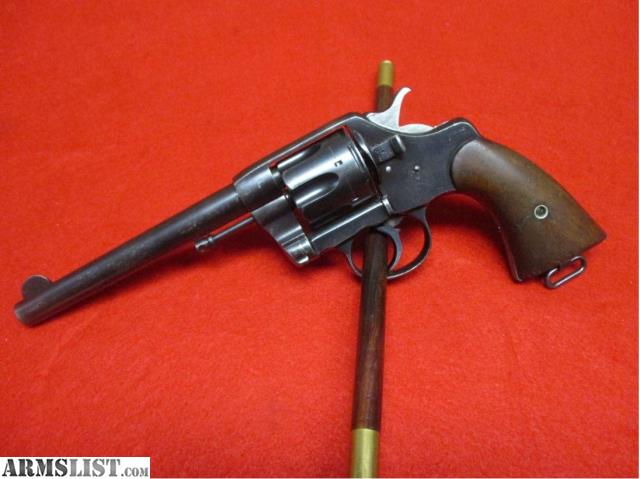
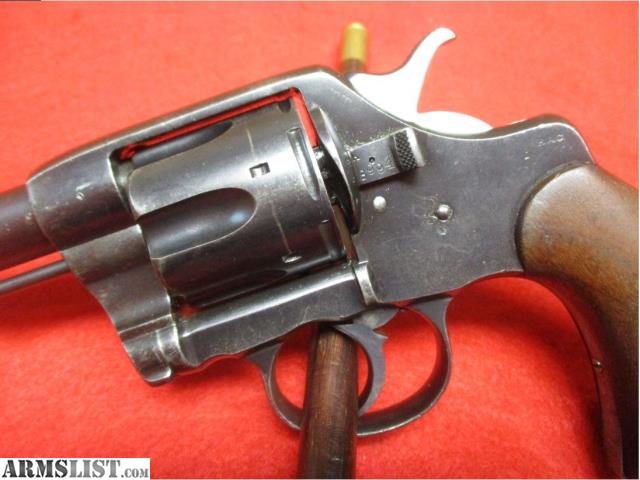
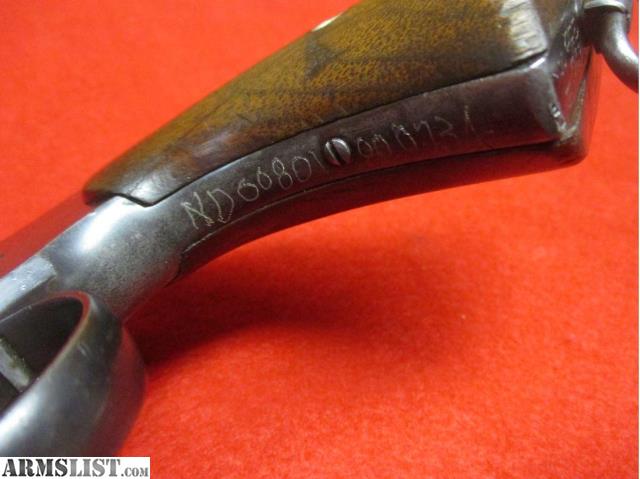
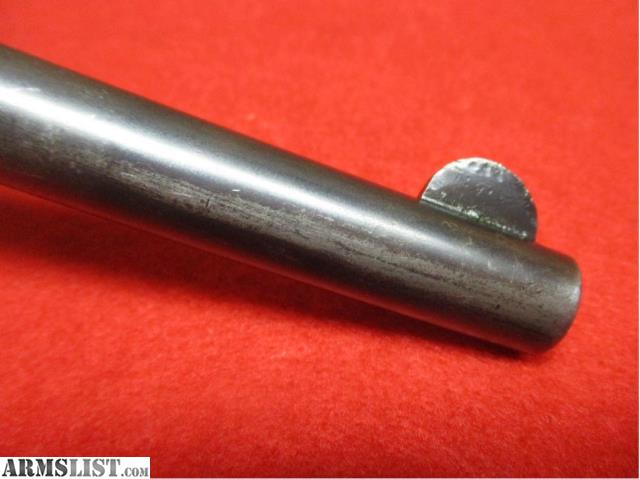
The M1901 was developed from a series of Colt revolvers, starting primarily with a Model 1892. The M1892 was designed to replace the Model 1873 in U.S. Army service. Army trials with the Navy Model 1889 (the first Colt with a swing out cylinder) between 1890 and 1891 showed that design’s weaknesses in its locking system. The cylinder could potentially turn when holstered. Modifications to the design resulted in the Model of 1892 which was accepted for service. The 1892 is strange compared to later Colt revolvers as its cylinder turns counter-clockwise like the Smith & Wesson hand-ejectors. Unfortunately, direction of rotation would attempt to push the yoke/cylinder unit out of the frame as the trigger was pressed. Wear over time would eventually result in the cylinder being out of time. As a result of these findings, improvements were made to the locking mechanism resulting in the Model 1894/1896 Army Model. Ultimately, these two became the model of 1901 which was essentially a Model of 1894 with a sling swivel added. The final Model of 1903 changed the bore diameter slightly. The Army Model’s true Achilles heel, however, was the cartridge it was chambered for, the .38 Long Colt. During the Philippines Campaign (1899-1902), it was found the .38 LC had little stopping power against charging enemy combatants wielding machetes, even with multiple hits. For this reason, the M1892/1894/1896/1901/1903 models were ultimately replaced by the .45 Colt-chambered M1909 New Service revolver in 1909. The revolver presented here is a military-issue Model 1901 produced in 1903. It has a 4.5” barrel and walnut grips. The bluing is in fairly good condition with some wear. Sadly, someone had their serial number stenciled on the front of the grip, i.e. the front strap. It is actually rather light and could possibly be polished out. The side of the frame has the famous RAC inspector’s acceptance stamp. Mechanically, the pistol has only one issue. As the hammer is cocked and the trigger pulled, the hammer moves forward as it should. At this point, the revolver has not done anything out of the ordinary. However, as the trigger is released and begins to move forward, the cylinder suddenly rotates clockwise by 1 degree, i.e. the wrong direction for a Model 1892/1894/1896/1901/1903. This is most likely related to the issues mentioned near the top of this description. In the end, it seems that the counter-clockwise-rotation design could not be corrected to eliminate these errors. This was obviously unacceptable to Colt and is likely one of the reasons why they eventually switched to a clockwise-rotation system for all of their designs, the Colt New Pocket Model already featuring this system as far back as 1893. One wonders why the switch was not performed on the New Army Model of 1894 when the New Pocket already proved a clockwise rotation was more reliable in the long term. The bore of the Model 1901 is in pristine condition with no rust or pitting. The trigger pull is somewhat heavy compared to later Colt DA revolvers. Still the M1901 was important step in the evolution of Colt’s revolvers and it can be said that the lessons learned here directly influenced the decision to switch to the clockwise rotating cylinder and tighter lockup that Colt’s DA revolvers are famous for. A word of caution. Most revolvers chambered for .38 Long Colt do not have shoulders inside the chambers to allow the use of the .38 Short Colt (which uses an outside lubricated bullet like the .22 Long Rifle; frontal bullet diameter is .375”). As a result, the longer .38 Special will fit inside the chamber. No revolver in .38 Long Colt should ever be fired using the .38 Special as this is beyond the pressures the revolver was designed to handle.